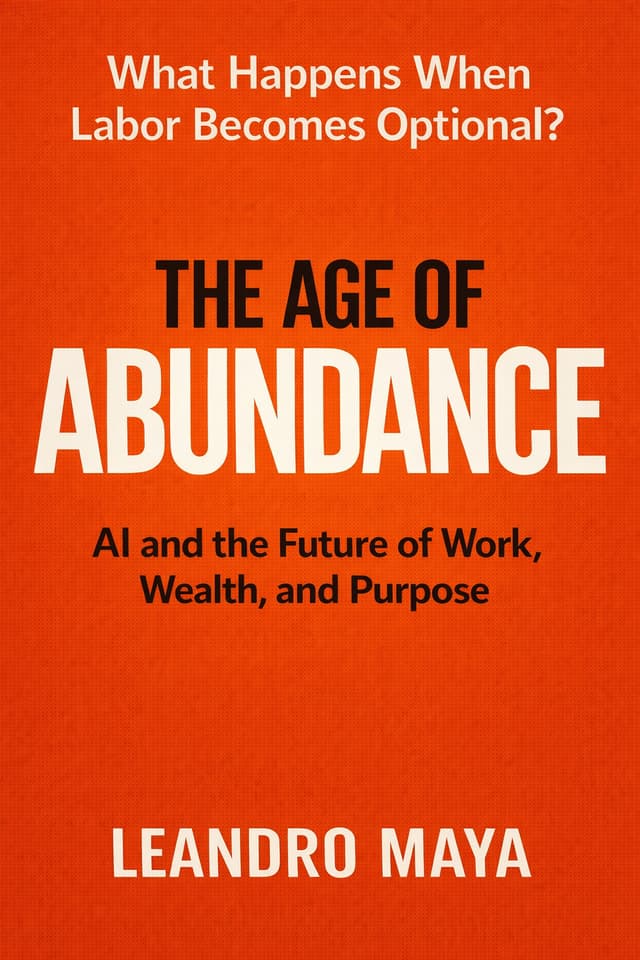
BOOK 1 OF THE AGE OF ABUNDANCE SERIES
The Age of Abundance
AI and the Future of Work, Wealth, and Purpose
Available in Kindle, Paperback, Hardcover and Audible
By Leandro Maya. Career at Apple, Meta and Circle.
What You Will Understand
Why this wave of automation is structurally different from every previous disruption — and why 'the market will adjust' is not a sufficient answer
The Ladder Problem: why automation breaks the economy from the bottom up, not the top down, and what that means for education, careers, and social mobility
The four-step economic engine driving labor costs toward zero — and the industries where it is already playing out
Why the destination of the automation era is abundance, not collapse — and the specific mechanisms that could make goods, healthcare, and energy dramatically cheaper
The Distribution Problem: how wealth gets shared when machines do the work, and why this is the defining policy challenge of the next fifty years
Reviews on Amazon US
A Book That Makes the Complex Feel Urgent and Personal
There are books about AI and automation that leave you more confused than when you started, buried under jargon and statistics. The Age of Abundance is not that book. Leandro Maya tackles one of the most consequential topics of our time with a clarity and groundedness that is genuinely rare.
Cristine Babot . Amazon US . May 2026
This Book Quietly Rewires How You See the Future
The Age of Abundance isn't just another AI book throwing around buzzwords. It's one of the few that actually connects the dots between technology, economics, and human behavior, and makes you feel what's coming, not just understand it intellectually. The 'Ladder Problem' concept alone is worth the price of the book.
Sagar Sudhir Behere . Amazon US . April 2026
Great book
Easy to read and very down to earth. Very interesting to look ahead and think about how the future will look like, and how to prepare for it.
Cristiano Chiaramonte . Amazon US . May 2026
One of the most impactful books I've read
The Age of Abundance isn't trying to impress you. It quietly changes how you see things. It pulls together technology, economics, and human behavior in a way that doesn't just explain change, it makes you feel the weight of it. It's one of those rare books that doesn't stay on the page. It stays with you.
Laura M. . Amazon US . April 2026
AI made appetizing for the masses
Maya connects the dots between technology, economics, labor, energy, geopolitics, and human meaning, the latter of which is often overlooked by industry experts. A call to action for individuals, institutions, and societies to design a future that is not just abundant but dignified, meaningful, and inclusive.
Suzanne Grover . Amazon US . April 2026
A must read
Unlike many technical AI books out there, Maya includes personal narratives from his Brazilian upbringing and humanizes the complex economic shifts we are all facing. A vital read for professionals and for parents trying to navigate a world that is changing fast.
Luciano . Amazon US . April 2026
A must-read for anyone thinking about their future in an AI world
This book completely blew me away. What really got me was how Maya tackles the future of work in the age of AI, not with doom and gloom, but with a refreshing sense of possibility. It's the kind of book that shifts your perspective in a real, lasting way.
Amazon Customer . Amazon US . April 2026
AI will have broad societal consequences
Leandro has laid out compelling arguments for the likely impact of AI on most aspects of society in a clear, well-researched manner. AI is moving faster than most realize. Leandro's positioning about self-awareness and hope is a must read now, most especially for parents and employers.
Larry M. . Amazon US . April 2026
Beyond the hype: a structural look at our new reality
A well balanced roadmap for navigating the profound economic and social shifts triggered by AI and robotics. Maya's unique perspective from the front lines of finance and tech makes these complex structural changes feel both inevitable and navigable. A rare, intellectually honest work.
Sandro C . Amazon US . April 2026
Really thought-provoking read
Leandro connects the dots between AI, the economy, and what it all means for regular people in a way that's easy to follow without being dumbed down. It's honest about the challenges but optimistic about what's possible if we pay attention and prepare.
Amazon Customer . Amazon US . April 2026
Masterclass in the convergence of AI and robotics
Leandro Maya has written a book that is as urgent as it is optimistic. The Age of Abundance is a vital guide for making informed financial decisions and career pivots in an era of unprecedented change.
Gustavo G. Pinheiro . Amazon US . April 2026
Prepares you for what's coming at lightning speed
Leandro clearly lays out the future and the inter-connections. Worth a read to prepare for what is happening at lightning speed.
Julien Legoc . Amazon US . April 2026
About the Author

Leandro Maya built his career inside some of the most influential technology companies in the world: Apple, Meta and Circle. The Age of Abundance is the first book in a series examining how AI is transforming work, health, education and the very structure of society.
Table of Contents
18 chapters organized in five parts
Table of Contents
18 chapters organized in five parts
The Age of Abundance is available now on Amazon.
Kindle . Paperback . Hardcover . Audible